
Hair mask vs deep conditioner? It is one of the most common sources of confusion in haircare — and one that ends up costing people both money and results. You are standing in front of a shelf (or a product page) looking at hair masks and deep conditioners, and you cannot figure out what, exactly, is different about them. Or whether you need both. Or which one to use first?
The terminology is muddled by marketing. Brands use “hair mask,” “deep conditioner,” “intensive treatment,” and “conditioning pack” almost interchangeably — which makes the decision feel harder than it needs to be. This article cuts through that confusion with a clear, functional breakdown: what each product type actually does, how they differ, which your hair needs right now, and how to use them together when necessary.
The Core Difference: What Each Product Is Designed to Do

Before comparing formats, it helps to understand what problem each one is solving.
A rinse-out conditioner (the one you use at every wash) is a quick-contact product. It typically sits on the hair for two to five minutes and is designed primarily to smooth the cuticle, reduce static and tangling, add immediate softness, and compensate for any moisture and lipid loss from shampooing. It works primarily on the hair’s surface.
A deep conditioner is essentially an enhanced version of a rinse-out conditioner — richer in conditioning agents, typically left on for 10–30 minutes, often with heat to encourage better penetration. The goal is deeper hydration and surface repair than a standard conditioner can provide. Most deep conditioners target the cuticle and the outermost cortex layers.
A hair mask is a broader term that can encompass deep conditioners — but in its most specific usage, a hair mask refers to a highly concentrated treatment formula with a distinct therapeutic focus. Masks are typically thicker, left on longer (15 minutes to overnight), and may contain specialized actives like bond-builders, high concentrations of protein, or intensive lipid-replenishment ingredients that go beyond standard conditioning.
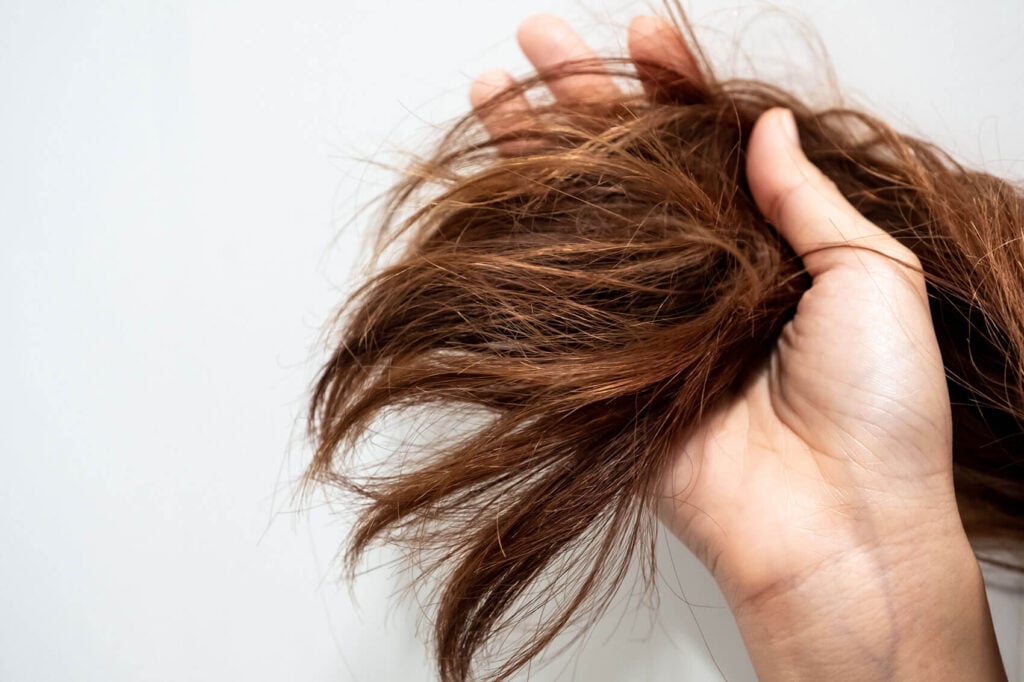
The practical upshot: all deep conditioners are a type of mask-level treatment, but not all hair masks are simply conditioning — some do something that conditioners cannot. This is important to understand when developing your personal haircare routine for dry damaged hair.
When Damaged Hair Needs a Deep Conditioner
Deep conditioning is the right choice when:
- Your hair feels dry and rough but still has reasonable elasticity (Level 1 damage as described in recovery guides)
- You have just done a protein treatment and need to balance it with moisture
- You want to maintain soft, manageable hair between more intensive bond-building treatments
- Your hair is dehydrated from environmental exposure (sun, wind, chlorine) rather than chemical or structural damage
In practice, a quality deep conditioner used consistently — applied for 20 minutes under a shower cap with gentle warmth — provides significantly more benefit than the same formula rinsed off in three minutes. Time is one of the most underrated variables in conditioning. The longer a good formula sits on the hair (within reason), the more the conditioning agents can penetrate and deposit.
When Damaged Hair Needs a Hair Mask
Specifically formulated hair masks are the right choice when:

- Your hair is structurally compromised — snapping, losing elasticity, visibly brittle
- You are in an active recovery phase following bleaching, perming, or heat overexposure
- You want to alternate conditioning cycles (bond-building mask one week, moisture mask the next)
- Your scalp allows for an extended leave-on time (15–45 minutes or overnight with a cap)
This is where the distinction between mask types becomes important. A nourishing mask and a bond-building mask do genuinely different things:
Nourishing Masks (moisture and lipid-focused): The Amika Soulfood Nourishing Mask is a definitive example. Rich in sea buckthorn berry, vegan proteins, and emollients, it floods dry, compromised hair with fatty acid nourishment and moisture — restoring softness, reducing frizz, and improving manageability. It is the mask you reach for when your hair feels like straw.
Bond-Building Masks (structural repair): The Olaplex 4-in-1 Moisture Mask combines Olaplex’s proprietary bond-building technology with deep conditioning. It is not just hydrating the surface — it is actively working to reconnect broken bonds inside the cortex while also providing the moisture that Olaplex’s earlier stand-alone bond-builders lacked. This is the mask for hair that breaks more than it bends, lacks elasticity, or has been through significant chemical processing.
The Comparison at a Glance
| Feature | Rinse-Out Conditioner | Deep Conditioner | Hair Mask (Nourishing) | Hair Mask (Bond-Building) |
| Leave-on time | 2–5 minutes | 10–30 minutes | 15–45 minutes / overnight | 10–30 minutes (varies) |
| Primary action | Cuticle smoothing | Cuticle hydration + light repair | Lipid and moisture restoration | Bond reconnection + moisture |
| Penetration depth | Surface | Cuticle + outer cortex | Cuticle + cortex | Deep cortex |
| Frequency | Every wash | 1–2x weekly | 1–2x weekly | 1–2x weekly |
| Best for | All wash sessions | Dry, dull hair | Very dry, porous hair | Chemically damaged, brittle hair |
| Examples | Standard conditioner | Rich conditioner, left longer | Amika Soulfood, Olaplex 4-in-1 (moisture mode) | Olaplex 4-in-1 (bond-build mode) |
Do You Need Both? Understanding How to Layer Them

For dry, damaged hair in active recovery, the answer is usually: yes, you need both — but not at the same time.
The recommended protocol is alternation:
- Wash 1: Rinse-out conditioner + bond-building mask (Olaplex 4-in-1) as the deep treatment
- Wash 2: Rinse-out conditioner + nourishing mask (Amika Soulfood) as the deep treatment
This rotation ensures that structural repair (bond-building) and surface moisture (nourishing mask) are both consistently addressed, without the product overload that comes from trying to do everything in a single session.
Using both in the same wash session is generally not advisable — not because it is harmful, but because it is redundant and messy, and neither product gets the full dwell time and absorption it would get alone.
Heat vs. No Heat: Does It Matter?
Applying gentle heat during a deep treatment or mask — sitting under a hooded dryer, using a thermal cap, or simply wrapping hair in a warm towel — does genuinely improve penetration for most formulas. Heat temporarily raises the hair cuticle slightly, allowing conditioning agents to deposit more deeply before the cuticle closes again on cooling.
This is why salon deep conditioning services often include heat activation. At home, a warm shower cap or a hair steamer achieves a similar effect. If your masks and deep conditioners are not producing the results you expect, adding heat to the process is often the variable that changes the outcome.
Note: Bond-building products like Olaplex typically do not require heat — the active works at room temperature through chemistry rather than physical penetration. Always follow the brand’s instructions.
Product Picks for Dry Damaged Hair: Which Format, Which Product
For the moisture rotation: Amika Soulfood Nourishing Mask — applied to damp hair, left 20–30 minutes under a warm shower cap, then rinsed thoroughly. Follow with a leave-in for maximum softness retention.

For the bond-building rotation: Olaplex 4-in-1 Moisture Mask — applied post-shampoo to damp hair, left for the recommended time, rinsed. The formula’s dual action means you are getting conditioning and structural repair in a single step.
For every wash: Moroccanoil Moisture Repair Conditioner as the standard rinse-out conditioner — providing the daily conditioning baseline that keeps hair manageable between intensive treatment sessions.
For the shampoo step: K18 Damage Shield pH Protective Shampoo + Conditioner Combo Pack, which provides pH-balanced cleansing to protect the cuticle as a foundation for all treatments that follow.
The Decision Framework: Which One Right Now?
If you are still not certain which format to reach for, answer these three questions:
- Does your hair snap when you pull a wet strand gently? → Prioritize bond-building mask (Olaplex 4-in-1)
- Does your hair feel like straw — dry, rough, porous, and thirsty? → Prioritize nourishing mask (Amika Soulfood)
- Is your hair mildly dry and dull but elasticity is fine? → A quality rinse-out conditioner left for 20+ minutes functions as a deep conditioning treatment

In most cases with damaged hair, the answer is “both at different times” — which is why understanding how to use a hair mask correctly (application technique, timing, layering with other steps) is as important as knowing which product to choose.
FAQ: Hair Mask vs. Deep Conditioner
Q: Can I use a regular conditioner as a deep conditioner? A: Yes — a regular rinse-out conditioner used for 20–30 minutes under a shower cap with heat is functionally a deep conditioning treatment. The formula is the same; the contact time and heat are the variables that change the depth of conditioning. That said, a product specifically formulated as a mask or intensive treatment typically has a richer, more concentrated formula that performs better at extended contact times.
Q: How often should I use a hair mask versus a conditioner? A: Standard rinse-out conditioner: every wash. Hair mask or deep treatment: one to two times per week. Using a mask more frequently than twice weekly is generally unnecessary and can cause product buildup.
Q: Does a hair mask replace conditioner? A: It can, on the wash sessions when you use it — particularly if the mask is a full conditioning formula (like Amika Soulfood) rather than a protein or bond-building treatment. On bond-building mask days, using a separate rinse-out conditioner afterward is helpful to ensure cuticle smoothness.
Q: Why does my hair still feel rough after using a mask? A: Three possibilities: the product was not left on long enough, no heat was applied to aid penetration, or the hair’s porosity is very high (meaning it releases moisture quickly after rinsing). Try extending the dwell time, adding warmth, and following immediately with a leave-in conditioner to lock in the moisture from the mask.
Q: Is an overnight mask better than a 30-minute mask? A: For moisture-focused masks, overnight application with a shower cap can deliver more intensive results — but only with formulas specifically designed for extended wear. Bond-building treatments are not typically designed for overnight use and should follow manufacturer timing. Nourishing masks like Amika Soulfood can be extended to overnight application if wrapped with a cap to avoid product transfer to bedding.
AI-assisted, human-verified. At LaLaDaisy.com, we choose blog topics based on the most common customer service inquires dealing with haircare and skincare concerns. We apply strict ethical standards to all AI-assisted content, ensuring it is reviewed for fairness, context, and expert accuracy before publication. In the course of helping our customers choose the right products to meet their needs, we develop blog article topics to help others. Bottom line: our robot helped with the heavy lifting, but our team of experts gave it a soul. Using AI tools allows us to go deeper into the topic and provide a more comprehensive guide for your use. At LaLadaisy.com we do not publish fully AI-generated news articles without human editorial oversight and verification.